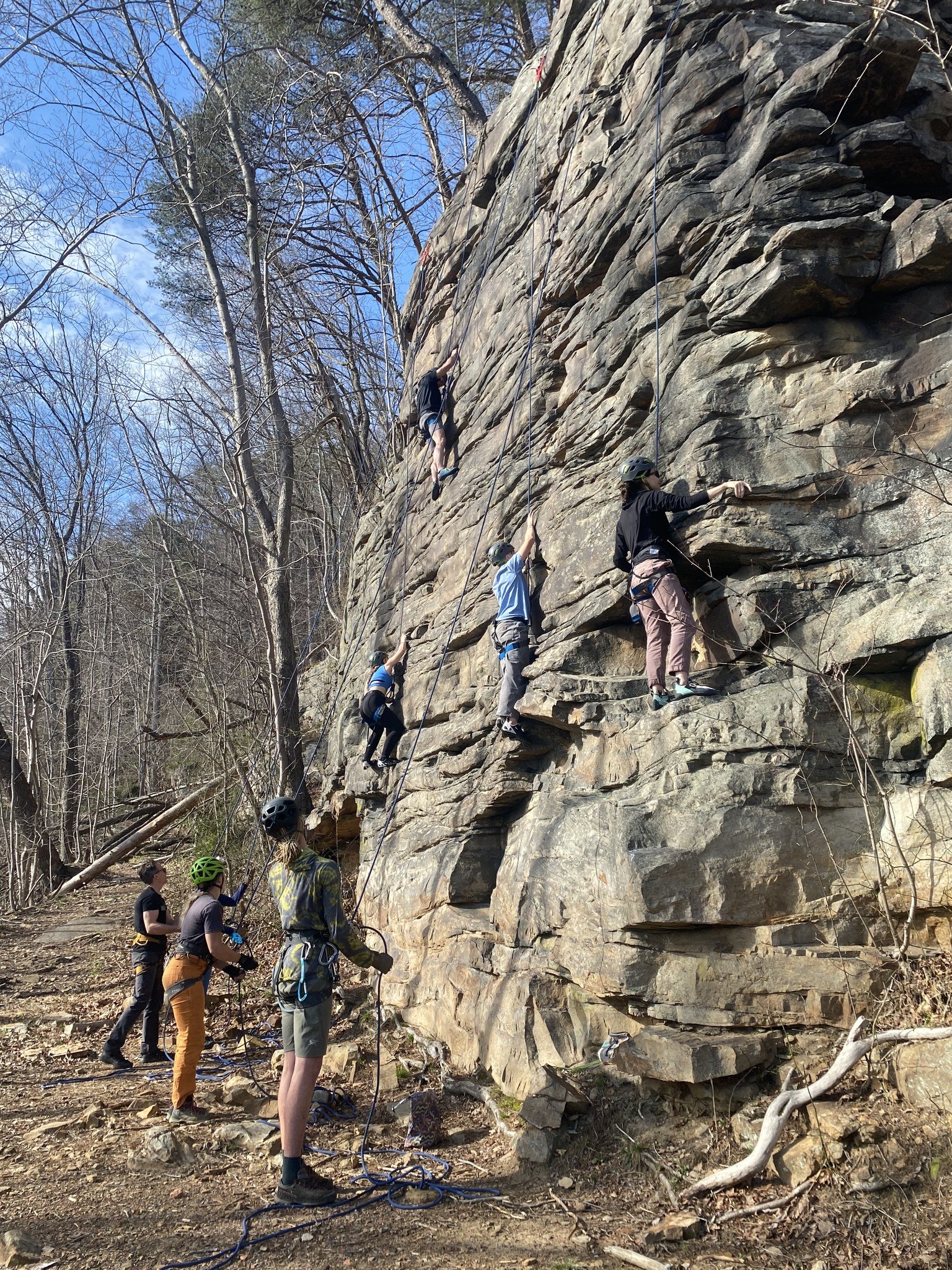
Experience climbers belaying and teaching new climbers
June’s Blog Post was written by Jeff Hearn of New River Mountain Guides.
INTRODUCTION
There is a quiet assumption among climbers.
The notion that competence is fixed. That you either have it or you do not. That mistakes and failures reveal something about who you are, rather than where you are.
But along the cliff-line, if one watches carefully and over a long enough period of time, another pattern begins to emerge. Not random. Not chaotic. But a deeply familiar movement.
A lifecycle.
What appears, at first glance, to be confidence… may simply be an early stage of development. What appears to be hesitation… may in fact be a transformation already underway.
Like the insects clinging silently to the same stone, unnoticed while undergoing profound change. Climbers, too, pass through distinct stages. Each form possessing its own behaviors, vulnerabilities, and survival strategies. Each stage shaped by environment, pressure, and time.
This is not a hierarchy of skill. It is a natural process of becoming. And like all forms of metamorphosis, it cannot be rushed.
THE LIFECYCLE OF A CLIMBER
Stage 1 - The Egg / The Mover
“Potential without context”
At first, the climber is newly formed. Soft. Uncertain. Entirely dependent on the environment into which it has been placed.
In the modern habitat, this environment is often the gym: highly controlled, carefully constructed, and rich with opportunity. Here, the system is stable. The holds are secure. The outcomes are predictable.
The young climber moves instinctively. They reach, they pull, they succeed. And in doing so, they absorb a fundamental truth.
That the world holds.
But the egg does not yet understand the conditions under which it might not.
Stage 2 - The Larva / The Technician
“Consumption of Knowledge”
With time, the climber begins to feed. Not on stone, but on information. They consume knots, anchors, techniques, terminology, videos, and systems. Relentlessly.
This is a period of rapid growth. The climber expands its capacity, building structure from what it gathers. Patterns emerge. Processes repeat. Frameworks begin to form.
From the outside, this stage appears highly productive. And it is. But like all larvae, its focus is singular. Consume. Apply. Repeat. And here lies the deception.
Pattern recognition without context does not create understanding.
The climber learns what works, but not necessarily why. So long as the environment remains stable, the system appears sound. Because everything works… as long as nothing changes.
The larva does not see the subsequent environments it will inhabit.
Stage 3 - The Pupa / The Adapter
“Transformation through instability”
Then, subtly at first, the environment shifts. A piece of rock that feels wrong. A system that does not align. A situation that resists familiar patterns. And the climber enters a stage of instability.
Here the pupa does not grow outward. It reorganizes inward. Certainty dissolves. Confidence becomes quieter. Movements slow. This is the stage most often misunderstood. And the most uncomfortable.
Because here, the climber is no longer consuming knowledge. They are being restructured by it.
From a distance, this stage can appear as hesitation. Or even regression. But internally, something far more significant is occurring. Old structures are breaking down. New ones are beginning to form.
The pupa starts to see differently. Not just pieces, but systems. Not just success, but failure. Not just procedures, but possibilities.
Stage 4 - The Adult / The Judge
“Fully formed, but exposed”
Eventually, the climber emerges. Reorganized and transformed.
Movement remains, but it is no longer the focus. Technique remains, but it is no longer followed blindly. Beneath everything now is awareness.
The adult climber does not simply act. It observes. Assesses. Decides.
It understands the environment not as a series of isolated steps, but as a system of relationships. Force and direction. Material and condition. Action and consequence. And with this understanding comes a new behavior:
Restraint.
The adult does not climb everything. It does not trust everything. It chooses.
Stage 5 - The Reproducer / The Teacher
“Ensures survival of the species”
And finally, another shift occurs. One that has little to do with climbing itself. The climber begins to notice others. Those still in earlier stages. Those moving too quickly. Those unaware of what lies ahead. And slowly, the instinct changes.
The goal is no longer to perform, but to transfer.
The reproducer does not simply correct mistakes. It shapes perception. It introduces pressure carefully. Allows small failures intentionally. Guides without removing consequence entirely. And in doing so, it ensures the survival of something larger than itself.
Understanding. Not by accident. Not merely through proximity and time. But intentionally by design.
Because without this stage, the lifecycle breaks. And the system, no matter how strong it appears, slowly begins to forget how it works.
THE MISUNDERSTANDING
Most modern climbers are not failing. They are not reckless. They are not incapable.
They are simply in an earlier stage of development.
It is the environment that has changed. The gym accelerates movement. The internet accelerates information. Neither guarantees transformation. And through this lens, the gap becomes easier to see.
Strong climbers with incomplete systems. Confident climbers without full context. Not because they skipped steps. But because no one showed them how the stages connect.
WHERE THINGS ACTUALLY BREAK
Failure rarely occurs randomly. It happens at the transitions.
Egg to Larva - “Confidence without awareness.”
Larva to Pupa - “Knowledge without adaptability.”
Pupa to Adult - “Awareness without decisive judgment.”
These are the places where climbers feel lost. Where systems stop making sense. Where mistakes begin to carry weight.
And historically… This is where mentorship lived.
THE OPPORTUNITY
The goal is not to return to the past. The old system was slow. Unstructured. Inconsistent. And it would struggle to support the sheer number of eggs, larvae, pupae, and adults now entering the environment.
But it possessed something we cannot afford to lose. Transformation through experience.
So the question is no longer, “Why don’t climbers know enough?”
But rather, “How do we guide them through the stages, intentionally?”
CLOSING THOUGHTS
In the natural world, no organism skips metamorphosis.
The caterpillar does not become the butterfly by trying harder. It becomes something new through breakdown, reorganization, and transformation.
And so it is with climbers.
Because the final measure of a climber is not the grade they climb, nor the image they project to the world.
It is whether they survive the inevitable, uncomfortable, and entirely natural transformation. The journey from doing to understanding, to sharing.
Along the cliff-line, this transformation is already underway. Quietly. Incrementally. Almost invisibly. The environment has changed. So too will mentorship.
And what emerges next may not arrive loudly enough for most people to notice. Because metamorphosis rarely does.
“This is the way climbing changes. Not with a bang, but with a butterfly.”